 openfluke
WELVET APP · 0.1.0+1 · v0.1 — Foundation
AI on your devices.
One AI engine. Multiple operating systems. Multiple hardware architectures. No cloud required. OpenFluke Welvet is a native, cross-platform program designed to run, train and serve AI models using the hardware you already own.
HONESTY · ROUND 1 BASELINE
Working means it runs — not that it is fastest or best.
The demo series and model matrix show working execution paths on real devices: native execution, compatibility, hardware portability and real-world functionality.
They are engineering demonstrations, not claims of maximum benchmark performance. A ✅ or a published timing means that path works in that build — not that Welvet is the fastest stack, the most polished product, or the final form of that model on that device.
Optimisation continues: kernel fusion, scheduling, memory efficiency, quantisation and device-specific work. The YouTube playlist is a round 1 baseline and will improve with every round.
One engine.
Your hardware. Your AI.
From desktop NVIDIA GPUs and Apple silicon to Qualcomm Snapdragon processors and older AMD Radeon graphics, Welvet aims to make local AI accessible across a broad range of devices.
Rather than requiring a separate AI infrastructure stack for every operating system, accelerator or model architecture, Welvet provides a unified execution environment with hardware-specific acceleration backends.
The cross-platform demonstration series showcases this approach in action. The same model assets can be reused across supported platforms, while the execution engine handles the relevant hardware backend.
Backend availability, model compatibility and performance vary by device.
THE OBJECTIVE
Build or obtain a compatible model. Deploy it to Welvet. Run it on a supported device.
That creates room for local AI development, edge computing, heterogeneous hardware clusters, and applications that do not depend on external inference services.
Run: use a supported model on your own machine.
Serve: turn a device into a local AI endpoint.
Reuse: keep the same assets across platforms.
Observe: see real outputs and timings on physical hardware.
DEMO SERIES · OPENFLUKE WELVET · ON-DEVICE AI DEMOS
Shared models across real machines.
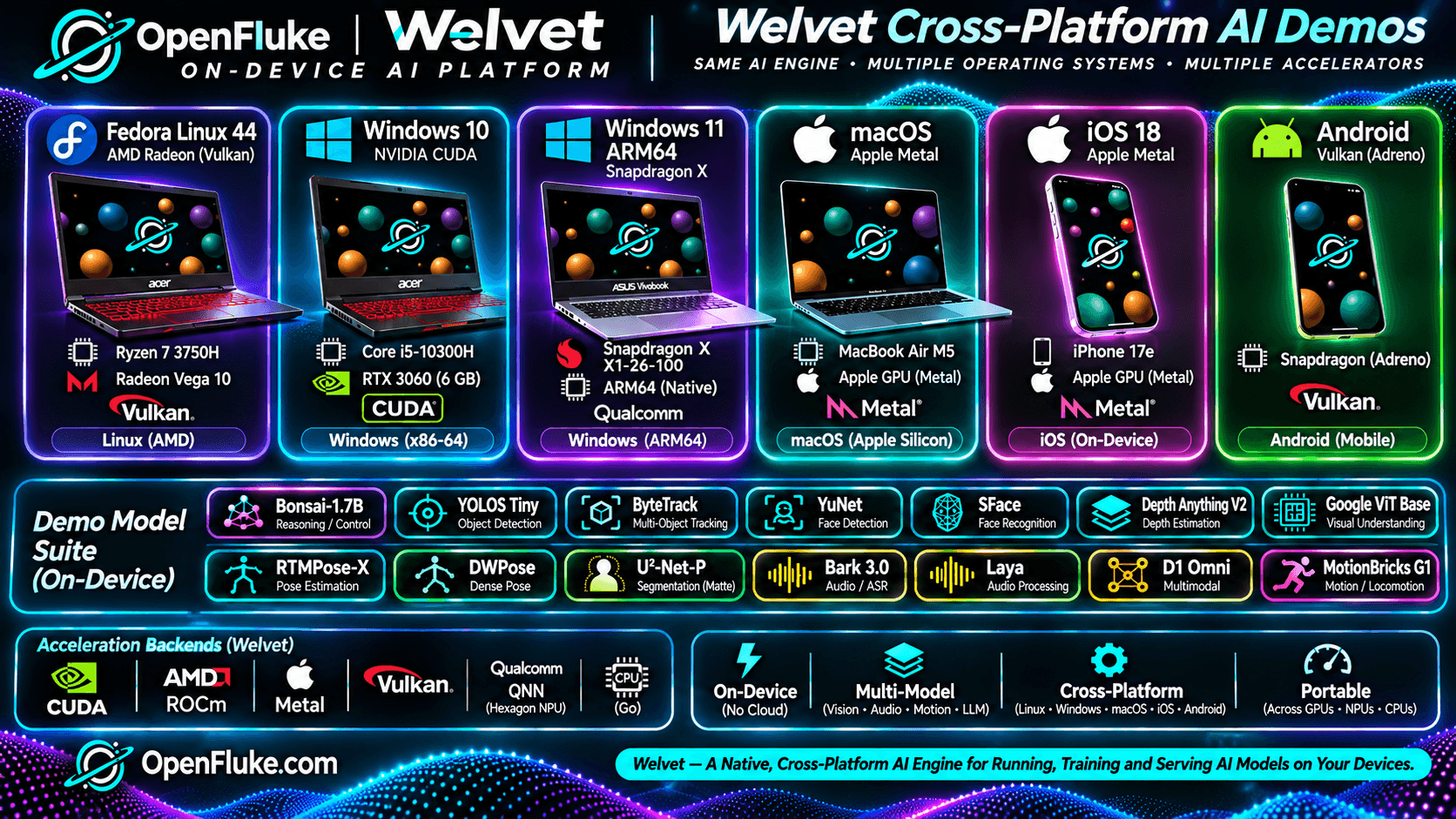
The series demonstrates a shared AI model ecosystem running across different operating systems, processors and GPU acceleration technologies — without requiring an entirely separate application and model ecosystem for each device.
| Platform | Test hardware | Processor / GPU | Acceleration |
|---|---|---|---|
| Fedora Linux | Desktop PC | NVIDIA GTX 1650 SUPER | CUDA |
| Fedora Linux 44 | Acer Nitro 5 AN515-43 | AMD Ryzen 7 3750H, Radeon graphics | Vulkan |
| Windows 10 x86-64 | Acer Nitro 5 AN515-55 | Intel i5-10300H, NVIDIA RTX 3060 | CUDA |
| Windows ARM64 | ASUS Vivobook 16 X1607QA | Qualcomm Snapdragon X X1-26-100 | Native ARM64 |
| macOS | Apple MacBook Air M5 | Apple M5 GPU | Metal |
| iOS | Apple iPhone 17e | Apple GPU | Metal |
| Android | Lenovo Legion Tab Gen 3 | Snapdragon 8 Gen 3, Adreno 750 | Vulkan |
Why cross-platform AI matters.
Most AI deployment workflows are heavily influenced by their target hardware. A model developed for a desktop NVIDIA GPU may require a different runtime, conversion process or deployment pipeline to operate on an Android phone, Apple silicon device or Qualcomm ARM64 computer.
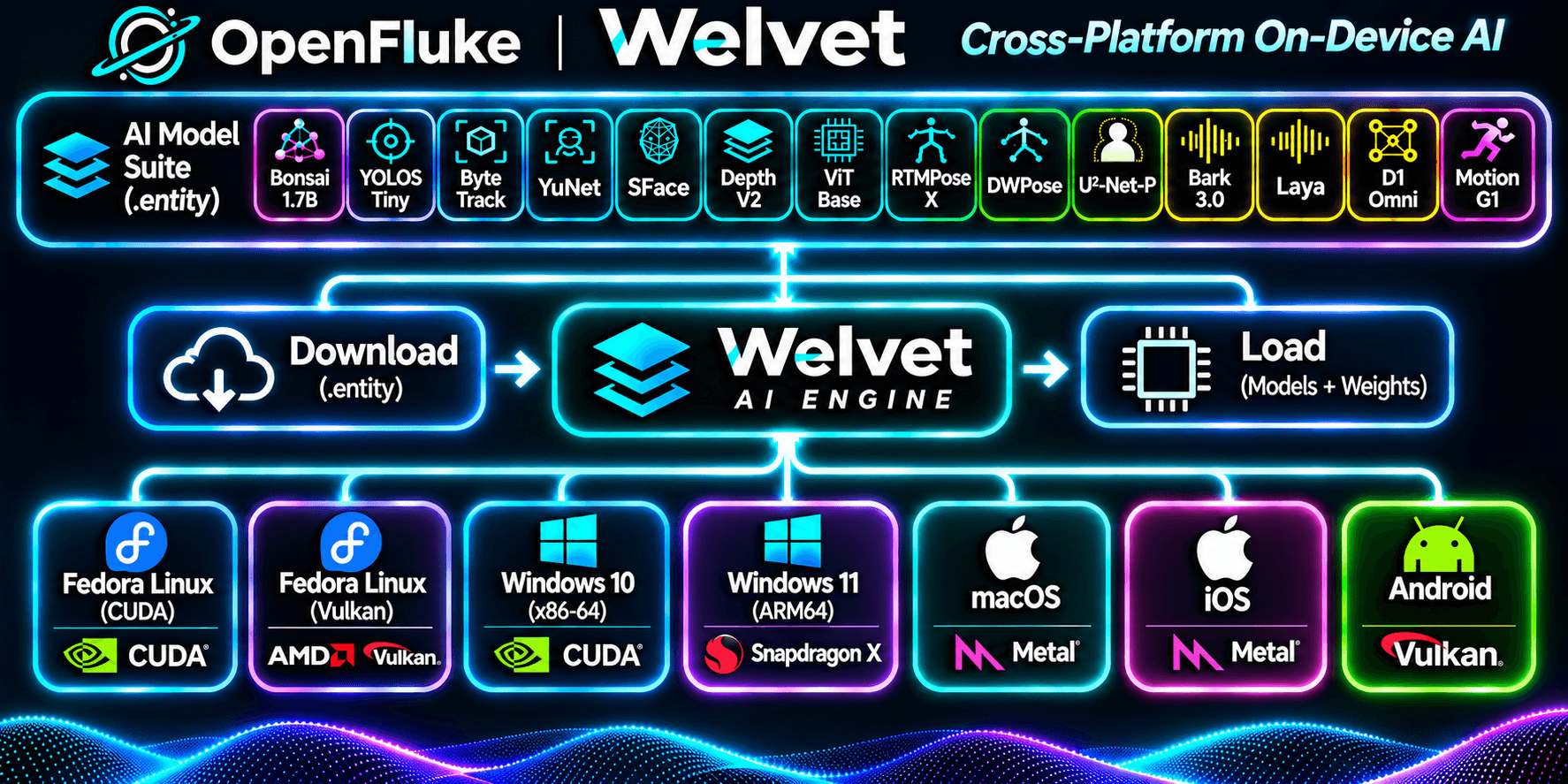
Welvet is designed to reduce this fragmentation. Its architecture separates model execution from the underlying hardware acceleration layer, enabling supported workloads to operate through different native backends.
Native hardware acceleration.
Welvet’s engine development includes support for several acceleration technologies. These are engine-level capabilities and development targets. They should not be interpreted as confirmation that every backend is enabled in every Welvet application build.
| Backend | Hardware ecosystem | Purpose |
|---|---|---|
| Native CPU | Supported desktop and mobile processors | General-purpose execution and fallback |
| NVIDIA CUDA | NVIDIA GPUs | GPU-accelerated model execution |
| Apple Metal | Apple silicon | Native GPU execution on Apple platforms |
| Vulkan | Compatible GPUs | Cross-vendor GPU compute |
| AMD ROCm | Supported AMD GPUs | AMD-specific GPU acceleration |
| Qualcomm QNN | Supported Qualcomm NPUs | Native neural processing acceleration |
| Native C++ host | Supported native platforms | Integration and execution interoperability |
VULKAN · CROSS-VENDOR GPU EXECUTION
Portability across manufacturers.
Unlike vendor-specific acceleration technologies, Vulkan provides a GPU compute interface available across multiple hardware manufacturers and operating systems. Welvet’s native Vulkan backend includes custom fused kernels intended to reduce execution overhead on compatible GPUs.
The demonstration series includes Vulkan on Qualcomm Adreno 750 under Android, and AMD Radeon graphics under Fedora Linux 44. The AMD demo is especially useful because it tests older consumer hardware, not only modern high-performance GPUs.
These demonstrations establish working execution paths. Additional optimisation remains an ongoing engineering task — working does not mean finished, fastest or best.
Multi-model AI demonstration suite.
Welvet is not limited to language models. The suite covers language generation, object detection, tracking, facial analysis, image classification, depth estimation, segmentation, pose estimation, audio processing and motion-related models.
Together these models show the breadth of workloads targeted by the runtime. Not every model is necessarily operational or accelerated on every platform. Individual demonstrations show the execution status and performance available in that particular build.
Language and decision
Bonsai-1.7B. A 1.7-billion-parameter model for local language generation and decision-oriented workloads on consumer hardware, including mobile.
Computer vision
YOLOS Tiny. Object detection and image understanding.
ByteTrack. Multi-object tracking, associating detections across successive frames.
YuNet. Face detection.
SFace. Facial feature embeddings and similarity comparison.
Depth Anything V2. Monocular depth estimation from image inputs.
Google ViT Base. Vision Transformer-based image classification and visual feature processing.
U²-Net-P. Foreground segmentation and image matting-related workloads.
Human pose and motion
RTMPose-X. Human pose estimation.
DWPose. Detailed human pose estimation.
MotionBricks G1. Motion and locomotion-related AI workloads.
Speech and audio
Bark 3.0. Speech and audio processing demonstrations.
Laya. Audio-related model execution.
Paradee-8M-v1.2. On-device text-to-speech narration used in the Linux CUDA demonstration.
Multimodal AI
D1 Omni. Multimodal AI model execution.
Full compatibility matrix for app 0.1.0+1: 15 approved models and backend status →
Performance and engineering validation.
Demonstrations prioritise real execution on physical hardware. Rather than presenting only theoretical compatibility, the demonstration application exposes model outputs and runtime measurements. Depending on the model, these may include:
- Inference and execution latency
- GPU processing time
- Preprocessing and postprocessing time
- Tokens generated per second
- Object detection and tracking outputs
- Model-specific results and visualisations
For example, early Android Vulkan testing on a Lenovo Legion Tab with an Adreno 750 GPU produced approximately:
| Workload | Observed result |
|---|---|
| Bonsai-1.7B | 11 tokens per second |
| SFace | 159 ms end-to-end |
| ByteTrack | 1–1.1 FPS |
| Laya | 568 ms per reported execution |
These are development observations, not standardised benchmarks or performance guarantees. Their primary significance is showing that different classes of AI workloads can execute locally through the same broader engine architecture. Further work can focus on kernel fusion, scheduling, memory efficiency, quantisation and device-specific optimisation.
Beyond inference: the Welvet vision.
The cross-platform demos represent one part of a larger objective. Welvet is being developed as an accessible local AI platform that combines model execution, training, deployment, hosting and monitoring.
Local AI hosting
The planned Welvet application aims to let users run and serve supported AI models directly from their own devices. A computer, laptop, tablet or phone could become a local AI endpoint for compatible applications — without assembling a traditional Python-based serving environment.
Distributed AI across devices
Longer-term vision: connect multiple devices into a local AI infrastructure. A desktop GPU could run a language model while a mobile device handles camera processing and another provides an additional inference service, over a local network through a common interface. Cluster management, workload distribution and container-based integration are part of the planned direction.
Training and continuous adaptation
The underlying engine explores training and continuous learning across multiple training approaches, numerical types and acceleration backends. The objective extends beyond static inference toward systems that can adapt during operation. Capability depends on the model, algorithm, numeric representation and hardware backend.
BioGraph and programmable AI worlds
The broader roadmap includes BioGraph: an environment for creating and exploring programmable simulations and AI-driven systems, with structured world definitions, scripting, simulation, visualisation and experimentation with AI behaviour.
Model telemetry and visualisation
A planned visual interface for observing model behaviour and execution — making neural network activity, performance, hardware utilisation and pipelines easier to inspect, rather than treating AI as an invisible process.
LOCAL OWNERSHIP
AI without mandatory cloud infrastructure.
A central principle behind Welvet is local ownership of computation. Where a compatible model and device are available, inference should not require sending data to a remote AI provider.
- Local processing of supported workloads.
- Reduced dependence on internet connectivity.
- Greater control over model deployment and data handling.
- Reuse of existing computing hardware.
- Flexibility to connect AI capabilities to custom applications.
- Reduced reliance on recurring hosted-inference costs.
Local execution does not automatically guarantee security, privacy or unlimited performance. Those properties also depend on application design, configuration, device capabilities and operating conditions.
Making existing hardware useful.
Not every AI application needs a high-end workstation or data-centre GPU. Many practical workloads can run on smaller models, quantised representations or specialised hardware.
Welvet aims to make it easier to experiment with these possibilities using devices people and organisations already possess — older laptops, desktop computers, mobile devices and heterogeneous combinations of hardware.
The broader goal is to lower the technical barrier between owning a capable device and putting that device to work on an AI task.
OpenFluke and the ALife ecosystem.
Welvet is also the AI infrastructure behind OpenFluke’s broader artificial-life and interactive software ambitions. The ALife ecosystem explores AI systems that learn, adapt and participate in simulated environments.
ALife: Becoming is a game centred on interactive artificial-life systems, learning through demonstrations, automation, physics and exploration.
ALife: Collective is a planned social mini-game experience exploring AI adaptation and persistent artificial-life characters.
Welvet provides the foundation for bringing AI models and execution capabilities into these experiences. The long-term direction includes connecting local models, simulated environments and applications through reusable interfaces. Welvet is also intended to be useful independently of the ALife games.
What comes next?
The immediate direction is to continue turning Welvet’s native AI engine capabilities into an accessible application. Priorities include improving model compatibility, accelerating execution, expanding deployment options, refining the user interface, and making local model hosting easier to use.
Future demonstrations will continue exploring different devices, processors, GPU architectures and AI workloads.
The goal is not simply to run one model quickly on one machine.
It is to make artificial intelligence practical across the devices people already own.
EXPLORE WELVET
OpenFluke Welvet · On-Device AI Demos
Watch the demonstration series to see supported models executing on real hardware across Linux, Windows, macOS, iOS and Android.
Website: openfluke.com · Developer: OpenFluke · Project: Welvet · App: 0.1.0+1 (v0.1 — Foundation)
Focus: Native AI execution, continuous learning, hardware acceleration, local hosting, and cross-platform portability.